
Ion Exchange Resins Market Forecast at USD 2.7 Billion by 2030 as Application Demand Broadens
Market Overview and Growth Outlook
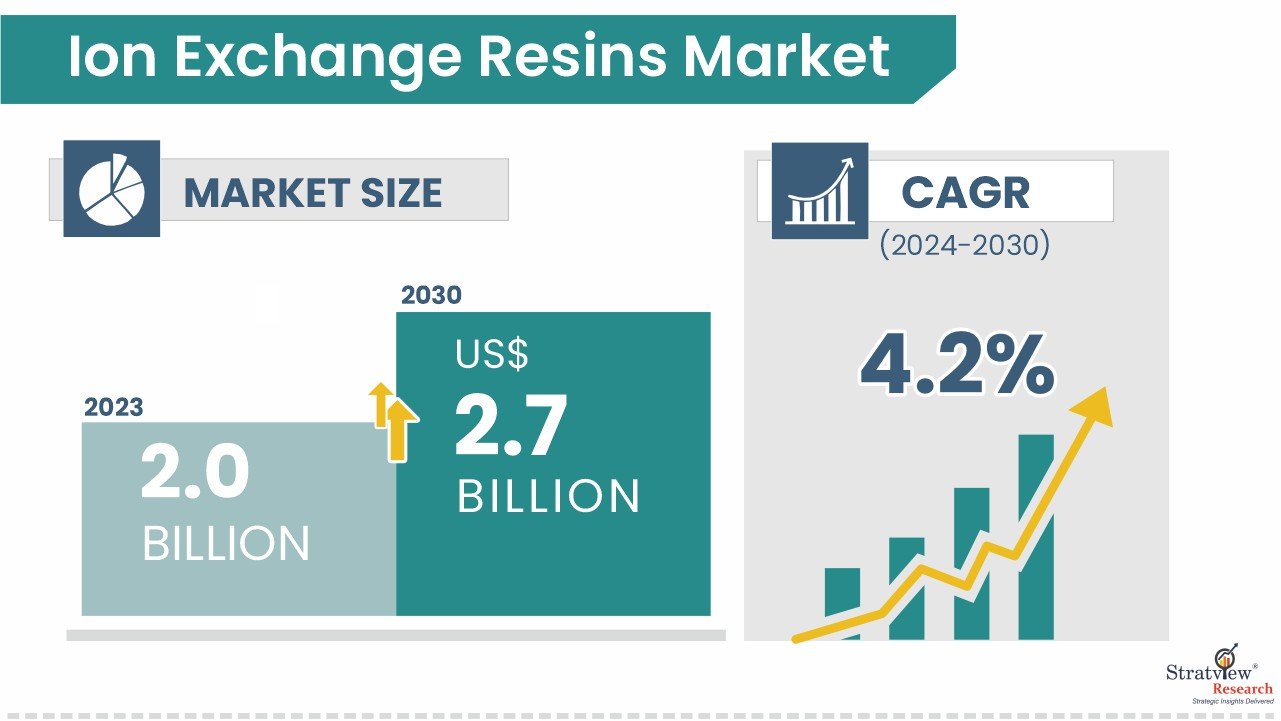
Valued at an estimated USD 2.0 billion in 2023, the Ion Exchange Resins Market is likely to reach USD 2.7 billion by 2030. Growth is being supported by demand for clean water, stringent environmental regulations, and industrialization in emerging economies. Ion exchange resins are critical in water treatment, power generation, chemical processing, and resource recovery, while food and beverage, pharmaceutical, and advanced catalysis applications contribute additional demand across the market.
Understanding the Ion Exchange Resins Market size requires examining the broad application framework supporting demand. Ion Exchange Resins Market size The materials are widely used in water purification, sugar refining, chemical processing, demineralization, and other industrial applications because they can effectively remove or replace ions. This functional role links the market outlook directly to purification requirements, processing activity, and expanding industrial applications rather than to a single end-use category.
The Ion Exchange Resins Market is expected to grow at a CAGR of 4.2% during 2024-2030. Its growth trajectory is reinforced by environmental sustainability awareness, technological developments in specialized resins with improved performance, and growing infrastructure. Ion exchange resins also contribute to recycling and the reduction of hazardous waste, adding another dimension to demand as industrial users address both processing requirements and environmental issues through purification and separation technologies.
Request a free sample report:
https://www.stratviewresearch.com/Request-Sample/ion-exchange-resins-market#form
Market Segmentation Analysis
By End-Use Industry Type, the market is segmented into Water & Wastewater Treatment, Food & Beverage, Power, Electronics, Chemicals, and Others. Water & Wastewater Treatment is anticipated to grow fastest in the coming years. Increasing concerns about water pollution and contamination are driving demand for effective purification technologies. Governments are also tightening environmental regulations concerning treated wastewater discharge and advanced purification systems, strengthening demand for ion exchange resins within this end-use category.
By Type, the Ion Exchange Resins Market is segmented into Cationic, Anionic, and Others. Cationic resin is projected to maintain its dominance throughout the forecast period. These resins remove positively charged ions such as calcium and magnesium, a function essential to water softening and demineralization. Their cost-effectiveness and use in water and wastewater treatment, food and beverage, and power industries further support their market position and relevance across the industry intelligence landscape.
By Region, the segmentation comprises North America, Europe, Asia-Pacific, and The Rest of the World. Asia-Pacific holds the largest market share and is projected to grow the most in the coming years. This positioning makes Asia-Pacific central to the regional analysis, while the complete geographic scope also covers North America, Europe, and Rest of the World markets included within Stratview’s segmentation framework for the forecast period.
Regional Market Insights
Asia-Pacific is both the largest market and the region projected to grow fastest. Rapid industrialization across China, India, and Southeast Asian nations is increasing demand for water purification, demineralization, and dealkalization applications where ion exchange resins are used. Population growth and urbanization are simultaneously increasing clean-water demand, which is driving investment into advanced water treatment technologies. These factors collectively reinforce Asia-Pacific’s leading position within the Ion Exchange Resins Market.
Emerging Trends Shaping the Ion Exchange Resins Market
Specialized resin development is becoming an important element of industry trends. LANXESS announced an ultrapure series of ion exchange resins in 2023 for oxygen removal, catalytic removal, and electronics applications. Mitsubishi Chemical Group announced an increase in production capacity in October 2024 for ion exchange resins used to produce ultrapure water for semiconductor manufacturing, showing how product development and capacity expansion are addressing defined high-performance purification requirements.
Market activity also includes portfolio consolidation and manufacturing expansion. Ecolab acquired Purolite in December 2021, while Thermax Limited acquired TSA Process Equipment in February 2024. DuPont announced an expansion of ion exchange resin manufacturing production in June 2021 to address high global demand. Taken together, these disclosed developments show established companies using acquisitions, portfolio strengthening, capacity additions, and targeted product innovation as part of the evolving competitive landscape.
Key Growth Drivers of the Market
- Clean-water requirements: Higher demand for clean water increases the need for effective water purification technologies and supports ion exchange resin consumption.
- Environmental regulation: Stringent requirements governing treated wastewater discharge encourage the adoption of advanced purification systems that use ion exchange resins.
- Emerging-economy industrialization: Industrial development increases requirements across water treatment, power generation, chemical processing, and resource recovery applications.
- Infrastructure and sustainability: Growing infrastructure, recycling activity, hazardous-waste reduction, and sustainability awareness expand the role of ion exchange technologies in environmental and industrial applications.
- Improved resin performance: Technological developments in specialized resins strengthen adoption by supporting demanding applications such as ultrapure water production and electronics processing.
Competitive Landscape
Top Companies in the Market
- DuPont
- Purolite (Ecolab)
- LANXESS
- Mitsubishi Chemical Group
- Jacobi Resins
- Ion Exchange
- Thermax
- SAMYANG
- SUNRESIN
- Zhejiang Zhengguang Industrial Co., Ltd.
The market is consolidated, with a few participants holding a fair market share across regions. Water purification and demineralization remain important product applications among key companies, while ion exchange resin applications are steadily expanding across industries. Strategic insights from recent company activity show a combination of acquisitions, manufacturing expansion, and specialized product introductions, providing a clearer view of how established participants are responding to changing application requirements within the competitive landscape.
Conclusion and Strategic Outlook
The Ion Exchange Resins Market is positioned to move from USD 2.0 billion in 2023 to USD 2.7 billion by 2030 at a 4.2% CAGR during 2024-2030. Market intelligence points to clean-water demand, regulation, industrialization, infrastructure development, sustainability, and improved specialized resins as central growth factors. With Water & Wastewater Treatment expected to grow fastest and Cationic resin maintaining type dominance, the market forecast remains anchored in practical purification and processing requirements.
FAQs – Ion Exchange Resins Market
1. How large is the Ion Exchange Resins Market?
The Ion Exchange Resins Market was estimated at USD 2.0 billion in 2023. It is likely to reach USD 2.7 billion by 2030.
2. What is the forecast CAGR for the Ion Exchange Resins Market?
The Ion Exchange Resins Market is projected to record a CAGR of 4.2% during 2024-2030. This market forecast covers the period through 2030.
3. Why is demand for ion exchange resins increasing?
Clean-water demand, stringent environmental regulations, and industrialization in emerging economies are identified as core drivers. Sustainability awareness, infrastructure growth, recycling, hazardous-waste reduction, and improved specialized resin technologies provide additional support.
4. What region has the strongest position in the market?
Asia-Pacific holds the largest share and is projected to grow fastest. Industrialization, population growth, urbanization, and demand for water purification, demineralization, and dealkalization support its market position.
5. What does the market outlook indicate for industry participants?
The Ion Exchange Resins Market is forecast to reach USD 2.7 billion by 2030, supported by a 4.2% CAGR. Stratview’s published market summary emphasizes demand and growth factors rather than identifying a specific market risk or challenge.









0 Comments